If you have no idea what is stock at all, I suggest you read the following first: Stock Market 101: Understand How Stocks Get Started.
To be successful in stock investing, the first thing that you want to do is to analyze the entire stock market as whole and learn how the majority investors behave in the stock market. The stock market index is the indicator to tell you how the market moves. It represent everyone present in the market place. :D
I personally invest in US stock and Malaysia stock market. So 2 stock market indices that I"m interested are Nasdaq Composite Index and KLCI.. The following charts show the 1 year histrory trend.
KLCI - FTSE Bursa Malaysia Large 30 Index
KLCI comprises of 30 largest companies in Malaysia with approximately 70% of the total market capitalization of the FTSE Bursa Malaysia 100 Index.
Nasdaq Composite Index
Nasdaq Composite Index comprise of over 4000 innovative and fast growing technology companies in United States of America.
Note: What I like about this chart is when you click on it, it shows you the technical analysis of the chart. You can then perform the "Technical Analysis" on those chart. Basically technical analysis helps you to make investment decisions based on the study of charts rather than the stock fundamental. Interesting isn't it? But this is still something new to me but I will share with you more later on once I"m familiar with it. :)
What I don't like about this chart is only able to display up to 1 year trend. To view more than 1 year trend, you will have to use Yahoo Finance. But Yahoo doesn't have a way to embed the stock chart in a website or blog.If you know, feel free to share with me.
P/S: What about you? There are lot of stock market indices out there. Which market index do you refer?
Tampilkan postingan dengan label Stocks Discussion. Tampilkan semua postingan
Tampilkan postingan dengan label Stocks Discussion. Tampilkan semua postingan
Minggu, 11 September 2011

Minggu, 10 April 2011
Bursa Malaysia KL Stock Portfolio System
This morning I was looking an alternative ways to track my MYR stocks than my conventional excel spreadsheet and I found the “MY PORTFOLIOS” in the finance.yahoo.com. So, what you need to do is:
Positions

Transactions

Well, there are few problems I don’t like about this Stock Portfolio feature from Finance Yahoo:
Let's Try KLStock.Com
So, I searched around again and I found www.klstock.com. It seems so far the best to suit my needs to replace my conventional stock tracking and monitoring with my excel spreadsheet.
[Update: Jan 17 2013] Apparently this KLStock.com website is no longer available and down. Thus, I"m removing the link.
Portfolio View

P&L History

Well, this website seems like a new website and I hope they will continue to make improvements to this website especially on the stock portfolio feature. One immediate enhancement I would request is to add the "commission charges” for both sell & buy transactions. Currently there is no way you can track it…
Overall, I have no complaints and you do a better job than “Finance Yahoo”. Please keep up the good work!
P/S: Feel free to suggest if you have better way to monitor or track your stock portfolio specifically for Malaysian stocks.
- Go to “finance.yahoo.com”.
- Login with your Yahoo account.
- Click “MY PORTFOLIOS” tab –> Select “Create Portfolio”.
- Choose “Track your transaction history”
- Follow the rest on the on-screen instructions to setup all you stock transactions.
Positions

Transactions
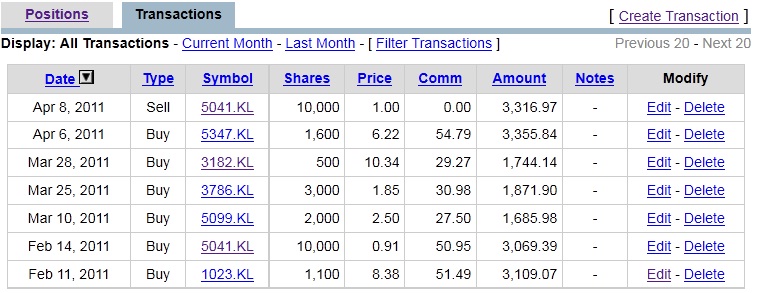
Well, there are few problems I don’t like about this Stock Portfolio feature from Finance Yahoo:
- The Symbol doesn’t display the counter name (e.g. displaying GENTING instead of 3182.KL).
- There is no currency for MYR. This is really suck.
- It doesn’t show how much your earning from you sell transaction. Huh?
Let's Try KLStock.Com
So, I searched around again and I found www.klstock.com. It seems so far the best to suit my needs to replace my conventional stock tracking and monitoring with my excel spreadsheet.
[Update: Jan 17 2013] Apparently this KLStock.com website is no longer available and down. Thus, I"m removing the link.
- Register an account with “www.klstock.com”
- Go to “portfolio” tab and key-in all your stock transactions
- For selling, you need to key-in your purchase transactions first. After that, click on the “sell” in the action column to key-in your sell transaction.
Portfolio View

P&L History

Well, this website seems like a new website and I hope they will continue to make improvements to this website especially on the stock portfolio feature. One immediate enhancement I would request is to add the "commission charges” for both sell & buy transactions. Currently there is no way you can track it…
Overall, I have no complaints and you do a better job than “Finance Yahoo”. Please keep up the good work!
P/S: Feel free to suggest if you have better way to monitor or track your stock portfolio specifically for Malaysian stocks.
Sabtu, 26 Maret 2011
Stock Market 101: Understand How Stocks Get Started
You buy shares from a certain stock and when the stock price goes up, you sell and earn money out of it. That is probably the main reason for all of us to invest in stock. But do you know why stocks exist at the first place? Is it for you to invest and earn money out of it? Yeah, that’s true. But then why the company want to issue a share for your benefits? Don’t forget that economy is always win-win…
Why stocks exist at the first place?
Stocks exist at the first place because companies want to raise capital (i.e. get more cash) for their business. Why companies want to increase their capital? Because they want to make their business big and eventually make even more money! Assuming a company wants to increase its capital to $1000K, the company will issue shares that worth for $1000K for investors to buy. Let’s say 100K shares are issued, 1 share will cost $1000K/100K = $10. When investors buy all these 100K shares, the company will able raise it cash or capital to $1000K.
You may also wonder why don’t the companies raise their capital from bank by taking loan. That is because taking loan has its limitation and you usually can borrow up to certain limit. Also, when you’re in debt you need to pay for the interest too. In order to get more money than what you can borrow from bank and most importantly without debt, the most effective way is to make your company listed in stock exchange by issuing shares to the public or in other words make your company a public company.
When your company is listed or became public, everyone can own part of your company by just buying shares from your company. For instant let's use the example above, you buy 1000 shares, you basically own 1K/100k = 1% of the company. If you buy 10K shares, then you own 10% of the company. Cool isn’t it?
How to determine the initial stock price?
Of course, the owners of a company decide what should be the initial stock price and how many shares they want to issue. However to determine the stock price, they must look from investors perspective. Let’s assuming you own this company and the annual net earning (i.e. net income – expenses) of this company is $100K. How much do you think your company worth? Let’s say you price your company worth for $1000K, this means that if I’m a investor and I invest $1000K. I will get back $100K annually as my return of investment – ROI which is $100/$1000K = 10% (assuming the earning is constant in the coming years). If you price your company for $500K, then the ROI from investors is 20%. The technical term for this ROI is called “Dividend”.
So do you think investors will invest for 10% ROI or 20% ROI? Of course, 20% right? But keep in mind that you only get the capital of $500K from a company perspective. What if you offer 10% ROI, do you think investors will invest? If yes, then you will get the capital of $1000K which is 2 times more than $500K. You get more money by offering 10% ROI as compared to 20% ROI. So, should you price your company $500K or $1000K? Well, that depends how good your judgement on what are the investors' need and to get the optimum capital that you want. :D
If you issue 1 share for $1000K (which is unlikely in reality because after you sell your share, your company no longer belongs to you!) , then 1 share will cost $1000K. If you issue 100K shares, then 1 share will cost $1000K/100K = $10. If you issue 1000K shares, 1 share will cost $1000K/1000K = $1. Do you think the public or investors have enough money to buy 1 share? So the quantity of the share decide how cheap is unit price per share that affordable by majority of investors. This is up to you to make a call too, if you’re the owner of the company.
Once you have decided to price your company for $1000K and issue 100K shares, your initial stock price will be $1000K/100K = $10 per share. So you make this offer to the public which is also called “Initial Public Offering (IPO)” with $10 per share.
Summary
Well, I summarized a lot of stuff here and in reality the process is a lot more complicated than what I have explained. I think it is always important to understand the basic fundamental especially from a company and investor perspective before we start investing in stock.
This article explains how stocks gets started in the first place. Feel free to comments and provide feedback if anything is not clear and you would like to discuss further. Happy investing!
Why stocks exist at the first place?
Stocks exist at the first place because companies want to raise capital (i.e. get more cash) for their business. Why companies want to increase their capital? Because they want to make their business big and eventually make even more money! Assuming a company wants to increase its capital to $1000K, the company will issue shares that worth for $1000K for investors to buy. Let’s say 100K shares are issued, 1 share will cost $1000K/100K = $10. When investors buy all these 100K shares, the company will able raise it cash or capital to $1000K.
You may also wonder why don’t the companies raise their capital from bank by taking loan. That is because taking loan has its limitation and you usually can borrow up to certain limit. Also, when you’re in debt you need to pay for the interest too. In order to get more money than what you can borrow from bank and most importantly without debt, the most effective way is to make your company listed in stock exchange by issuing shares to the public or in other words make your company a public company.
When your company is listed or became public, everyone can own part of your company by just buying shares from your company. For instant let's use the example above, you buy 1000 shares, you basically own 1K/100k = 1% of the company. If you buy 10K shares, then you own 10% of the company. Cool isn’t it?
How to determine the initial stock price?
Of course, the owners of a company decide what should be the initial stock price and how many shares they want to issue. However to determine the stock price, they must look from investors perspective. Let’s assuming you own this company and the annual net earning (i.e. net income – expenses) of this company is $100K. How much do you think your company worth? Let’s say you price your company worth for $1000K, this means that if I’m a investor and I invest $1000K. I will get back $100K annually as my return of investment – ROI which is $100/$1000K = 10% (assuming the earning is constant in the coming years). If you price your company for $500K, then the ROI from investors is 20%. The technical term for this ROI is called “Dividend”.
So do you think investors will invest for 10% ROI or 20% ROI? Of course, 20% right? But keep in mind that you only get the capital of $500K from a company perspective. What if you offer 10% ROI, do you think investors will invest? If yes, then you will get the capital of $1000K which is 2 times more than $500K. You get more money by offering 10% ROI as compared to 20% ROI. So, should you price your company $500K or $1000K? Well, that depends how good your judgement on what are the investors' need and to get the optimum capital that you want. :D
If you issue 1 share for $1000K (which is unlikely in reality because after you sell your share, your company no longer belongs to you!) , then 1 share will cost $1000K. If you issue 100K shares, then 1 share will cost $1000K/100K = $10. If you issue 1000K shares, 1 share will cost $1000K/1000K = $1. Do you think the public or investors have enough money to buy 1 share? So the quantity of the share decide how cheap is unit price per share that affordable by majority of investors. This is up to you to make a call too, if you’re the owner of the company.
Once you have decided to price your company for $1000K and issue 100K shares, your initial stock price will be $1000K/100K = $10 per share. So you make this offer to the public which is also called “Initial Public Offering (IPO)” with $10 per share.
Summary
Well, I summarized a lot of stuff here and in reality the process is a lot more complicated than what I have explained. I think it is always important to understand the basic fundamental especially from a company and investor perspective before we start investing in stock.
This article explains how stocks gets started in the first place. Feel free to comments and provide feedback if anything is not clear and you would like to discuss further. Happy investing!
Minggu, 06 Maret 2011
How to Embed Stocks that I am Watching?
If you're looking for a way to embed the stock charts in a website or a blog, you can now can do it through wikinvest. Here is my list of stocks that I"m watching and the chart shows 1 year history trend for that particular stock:
INTEL CORPORATION
ALTERA CORPORATION
If you have a better way to embed stock chart into a website or a blog, feel free to share. So far, I find this wikinvest is the best.
[02 April 2011]: There is a bug in the Malaysian stock chart which shows only until August 2010 and I have reported to wikinvest. This is the respond that I got from them:
[11 April 2011]: By the way, check it out my latest post on Stock Portfolio System to monitor or track your stocks. I find it pretty useful! :)
LOG
[03 March 2011]: Added AIRASIA BHD
[04 April 2014]: Removed CIMB Group Holdings Berhad, PBA Holdings BHD and Airasia BHD because it is no longer working. :(
P/S: Now you can spy on me because I will continue keep this post updated for the stocks that I"m watching.
[04 April 2014]: By the way, I no longer keep this post updated for my watched stock, will be remove this link from the right panel as well.
INTEL CORPORATION

ALTERA CORPORATION
If you have a better way to embed stock chart into a website or a blog, feel free to share. So far, I find this wikinvest is the best.
[02 April 2011]: There is a bug in the Malaysian stock chart which shows only until August 2010 and I have reported to wikinvest. This is the respond that I got from them:
Hi Champdog,
I filed a report of this issue when you wrote in a few days ago, and it's been added to our developer's work queue. I don't have a formal estimate at this time, but I'll keep you posted of our progress.
Thanks for your patience!
Wikinvest.com
Investing, Simplified.
[11 April 2011]: By the way, check it out my latest post on Stock Portfolio System to monitor or track your stocks. I find it pretty useful! :)
LOG
[03 March 2011]: Added AIRASIA BHD
[04 April 2014]: Removed CIMB Group Holdings Berhad, PBA Holdings BHD and Airasia BHD because it is no longer working. :(
P/S: Now you can spy on me because I will continue keep this post updated for the stocks that I"m watching.
[04 April 2014]: By the way, I no longer keep this post updated for my watched stock, will be remove this link from the right panel as well.
Langganan:
Postingan (Atom)